3 Days in Chengdu: The Itinerary That Made Me Rethink Every Other Chinese City
Why Visit Chengdu
Chengdu doesn’t scream for attention the way Shanghai or Beijing do. It sits there, flat and sprawling, making excellent food and apparently smoking more cigarettes than any other city in China. I say this as someone who spent the previous week in Chongqing, which is basically a cyberpunk fever dream built into a mountain. 3 days in Chengdu, by comparison, felt almost relaxed. Still busy, still Chinese-city busy, but less like the city was personally trying to overwhelm you.
We booked three nights in March and arrived via high-speed train from Chongqing. Locals told us summer gets brutally hot here, so March sits in that sweet spot where you can walk around without sweating through everything in your suitcase.
At a glance, you’ll want:
- One day for exploring the cuisine (cooking class, dining at affordable Michelin restaurants
- One day for exploring the city itself (walking tour and nightlife)
- One day dedicated to visiting one of the Panda breeding centers.
Day 1: The Chengdu Cooking Class and the Mapo Tofu Revelation
We booked a cooking class with Chili Cool China. Our guide was Jerry, and I mention him by name because he’s the reason this was one of the best activities we did across the entire trip, possibly the whole country.
The structure was simple: meet at a market near the Wuhou Temple area, walk through the stalls while Jerry explained what we were looking at. Spoiler: a lot of things I could not identify. Jerry made us try pure Sichuan peppercorn straight, no context, no warning really beyond a grin. My tongue went numb and stayed numb for what felt like way too long. Would still recommend it. There were vegetables I’d never seen before, luffa being the one I actually remember the name of, and stalls of things I didn’t have names for and didn’t ask. Also turtles, stacked up for sale, which is one of those market realities you don’t love seeing but also isn’t really yours to judge mid-trip. After the market, back to their kitchen to cook. Four dishes. Hands-on, not just watching someone else do the work while you take photos for Instagram.
Here’s the part I want to be honest about. I thought I made good mapo tofu. I had a recipe, I followed it, I felt confident. Then Jerry showed us how to do it, and I realized I had been making mapo tofu the way someone who has never been to Chengdu would make mapo tofu. The doubanjiang (fermented broad bean paste) is not negotiable. The hand-chopped beef, not pre-ground. The numbing from the Sichuan peppercorns needs to build, not hit you all at once and fade.
We now make this mapo tofu at home at least once a month. I am not exaggerating.
Cost: 450 RMB (~$67) per person.


Also: this was the only place in all of China that tried to ask for a tip. I want to be clear that I respect the hustle. But I also want the record to show this.
Day 2: Yulin’s Backstreets, People’s Park, and a chuanchuan xiang Skewer Dinner With No Menu
We did a free walking tour with a young enthusiastic student. These are hit or miss depending on the guide and group, and ours was excellent.
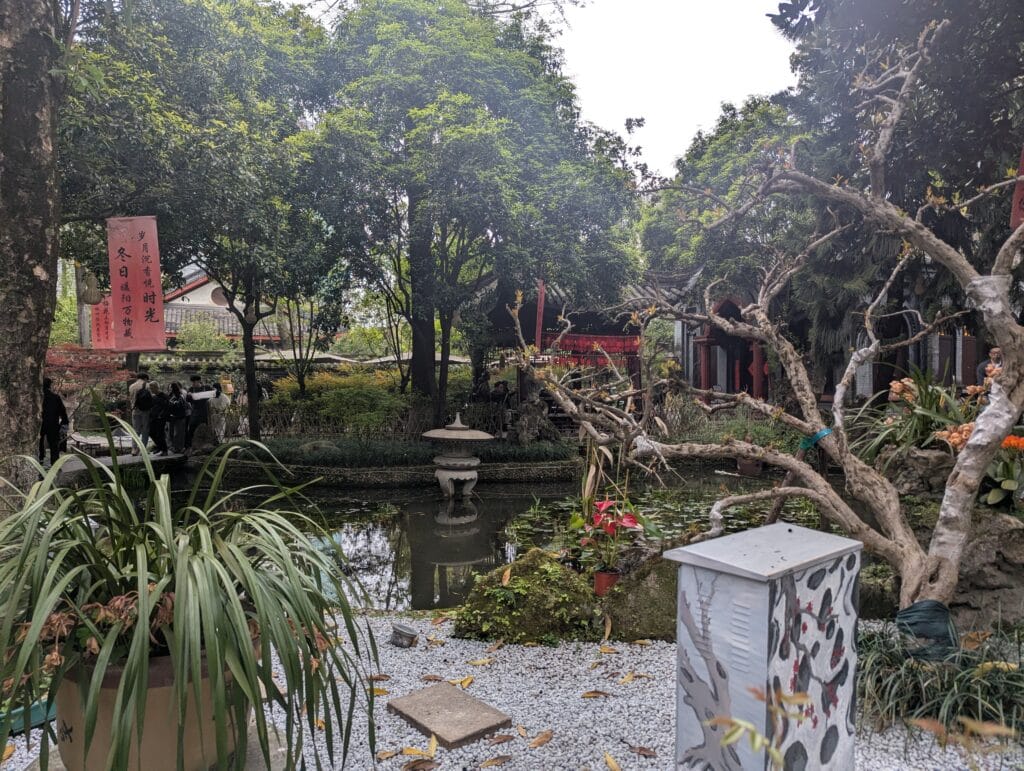
We began in People’s Park in the morning is exactly what you expect and still worth seeing. The tea houses are full of retirees. The dating corner is full of parents advertising their adult children like distressed assets. I sat there drinking jasmine tea and watching a man do calligraphy with a brush on the concrete, using water so it evaporated as he wrote. That’s the kind of low-stakes beautiful thing Chengdu does well.
After seeing the center and learning about the city and culture, she took us in a cab to the backstreets of Yulin are where the city actually lives… old men playing mahjong on folding tables, tiny restaurants with three plastic stools, groups of eldery people doing Tai Chi.
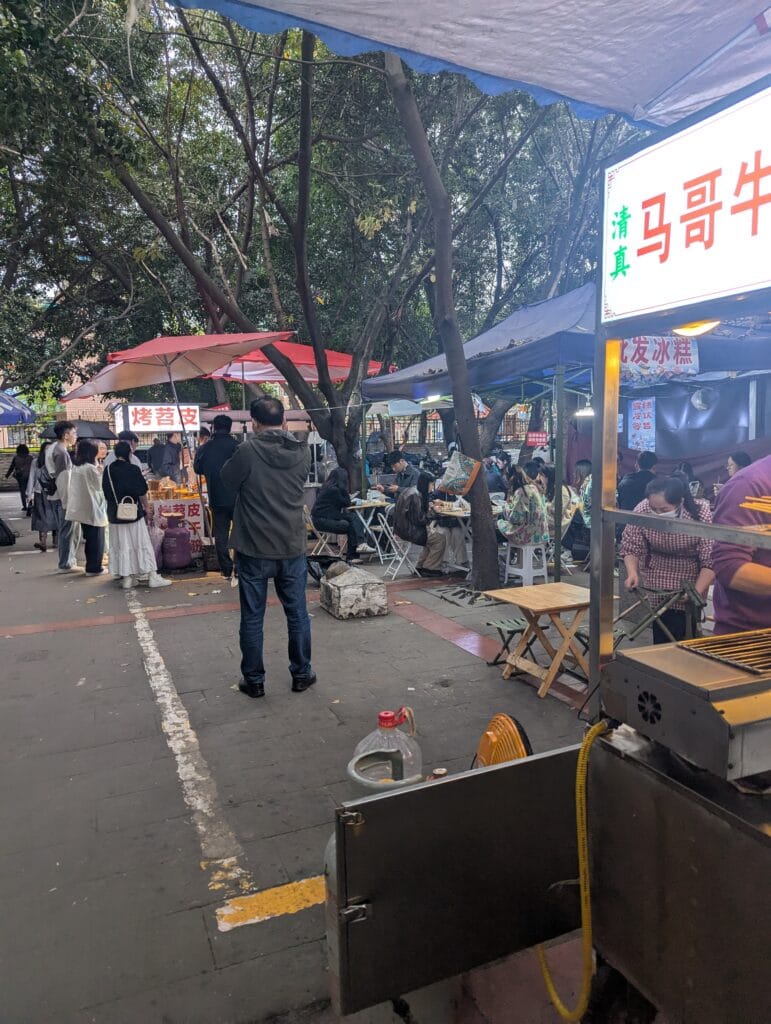
Dinner was chuanchuan xiang skewers at a place the walking tour guide recommended. I don’t remember the name. It was a room with a table and a pot of broth and hundreds of skewers on shelves. You grab what you want, cook it yourself, and they count the sticks at the end. Total came to maybe 60 RMB ($9). We were hesitant to take some skewers as we didn’t know what they were (and didn’t want to know honestly).
Book via freetour.com or GuruWalk.
IFS and Taikoo Li
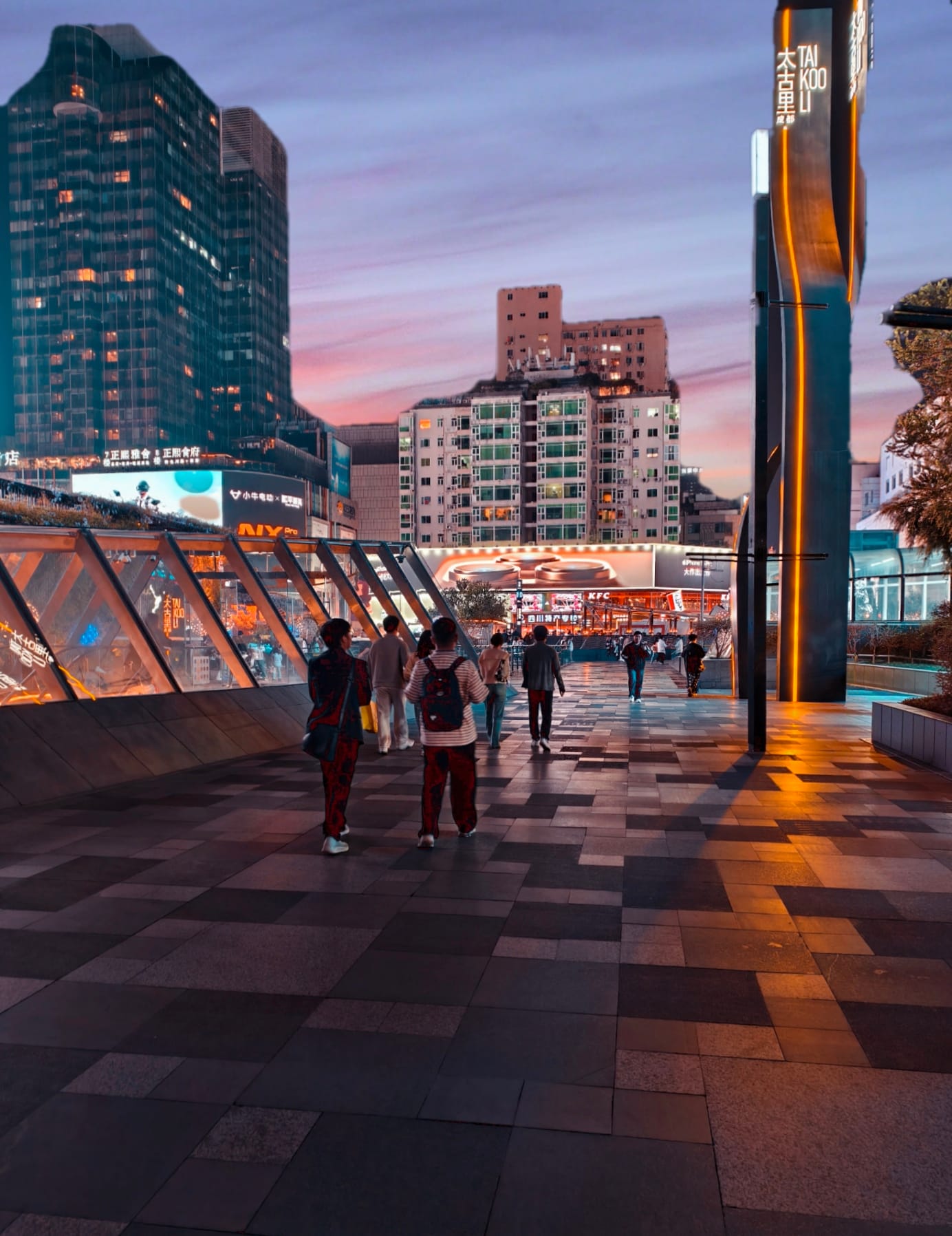
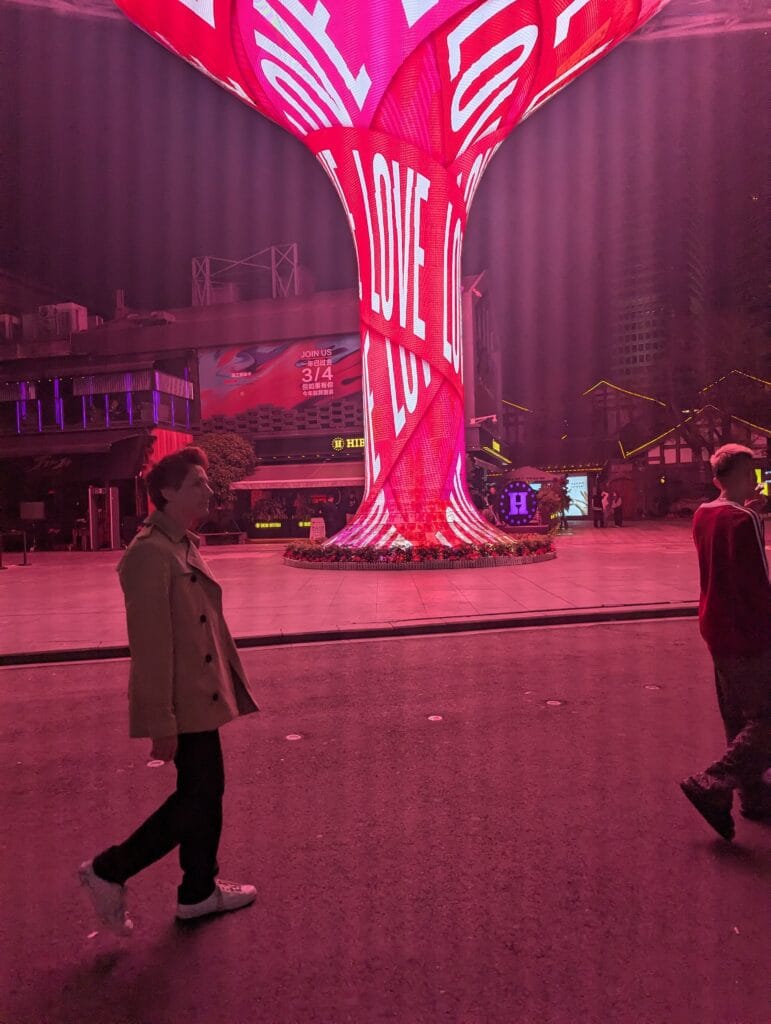
After dinner we wandered up to IFS and Taikoo Li, the luxury complex in the center of the city. It’s massive. Think open-air shopping street built around a restored temple complex, with every brand you’d find on any high-end street in any global city. Gucci, Louis Vuitton, the full roster. I’m not a mall person, but Taikoo Li is worth seeing even if you’re not buying anything. The architecture is thoughtful, the courtyards are genuinely pleasant at night, and there’s an energy to it that most developments of this scale don’t manage. The egg tart on the walkway connecting the two malls was the highlight, but that’s another section.
Nightlife Along the Jinjiang
Here’s where the city opened up. We walked down to the Jinjiang River and followed it toward Jiuyanqiao, the bar street near the Anshun Bridge. The bridge is lit up at night with classic Chinese pavilion-style architecture, and the whole stretch is basically a riverfront party. Club music spilling out of open doors. Street performers. Groups of friends drinking on the walkway. The river reflects everything and the humidity softens the edges.
It’s touristy, sure. But it’s also the most natural night scene in the city, and you can pick your energy level. Loud clubs if you want them. Quiet beer stops if you don’t. We walked the full stretch, stopped at a couple of places, and just watched the city do its thing at night.

Two Michelin-Starred Meals in Chengdu for Under $30 a Head
Chengdu’s Michelin scene has grown fast in the past few years, more than I expected from a city most people associate with pandas before food. We hit two of them, and I want to talk about both because they represent very different ends of the same spectrum.
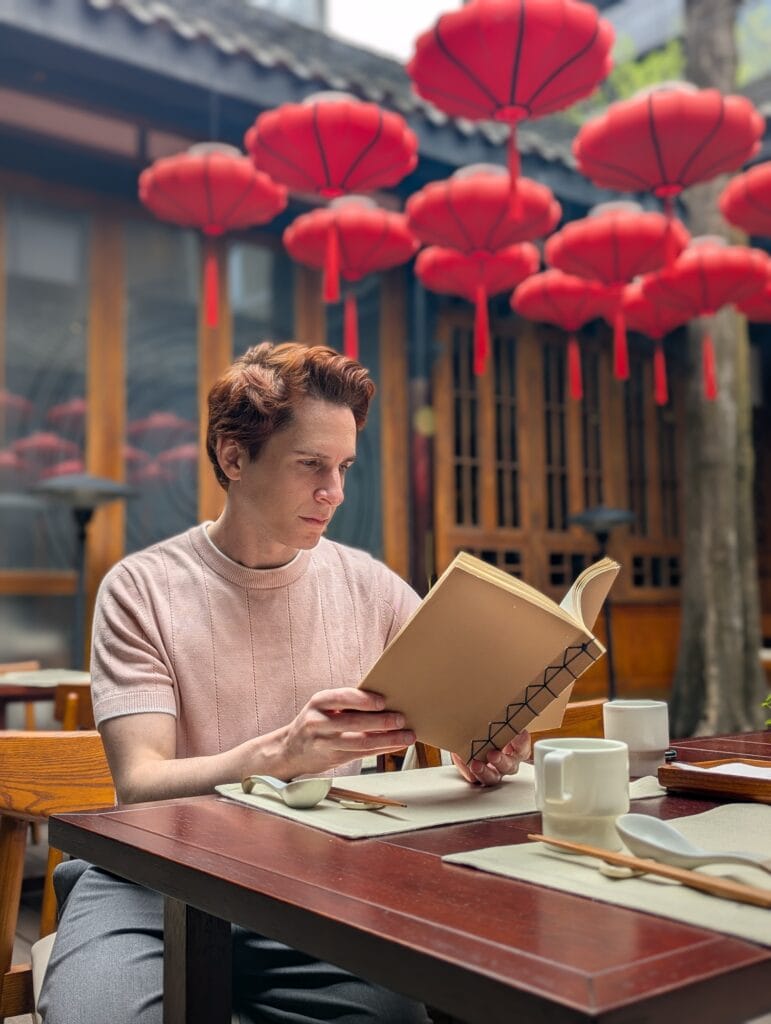
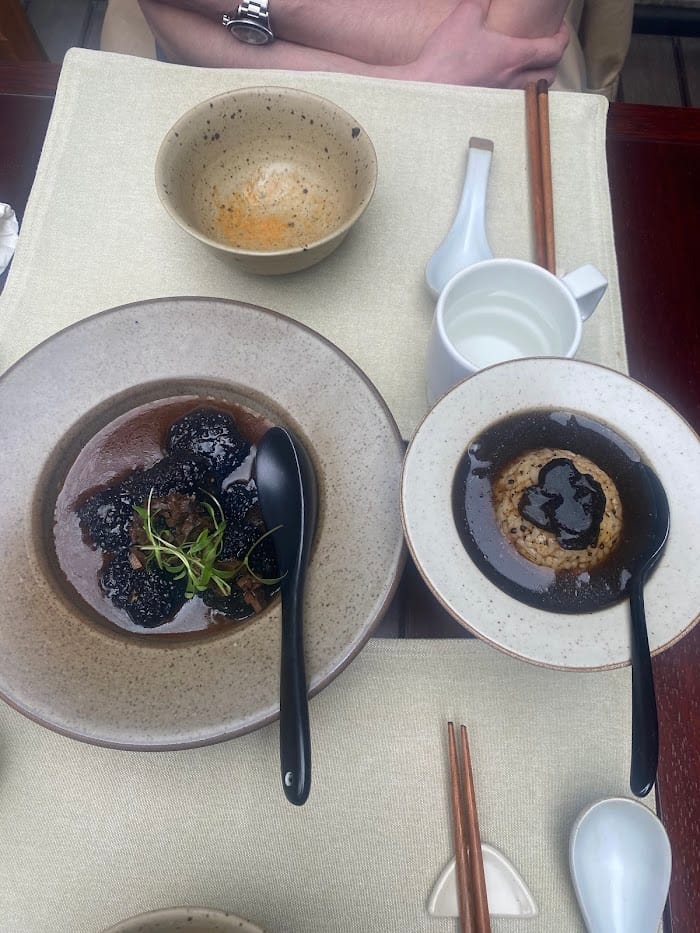
Mi Xun Teahouse is a one-star with a Green Star for sustainability, which means they care about where their ingredients come from in a way that is increasingly rare in high-end dining. It’s vegetarian. I know that might sound like a limitation, but it’s not. The tasting menu moves through textures and flavors in a way that makes you forget meat entirely. Lotus root with a sauce that tasted like someone had distilled five years of knowledge into a single bite. A dessert involving barley that I still think about.
Total bill was about $50. Split and shared between two people. I want to be very clear about that number because it’s the entire point. A Michelin-starred meal for roughly $25 per person. Go to New York and tell me what $25 gets you at a one-star. We didn’t order alcohol by the way.
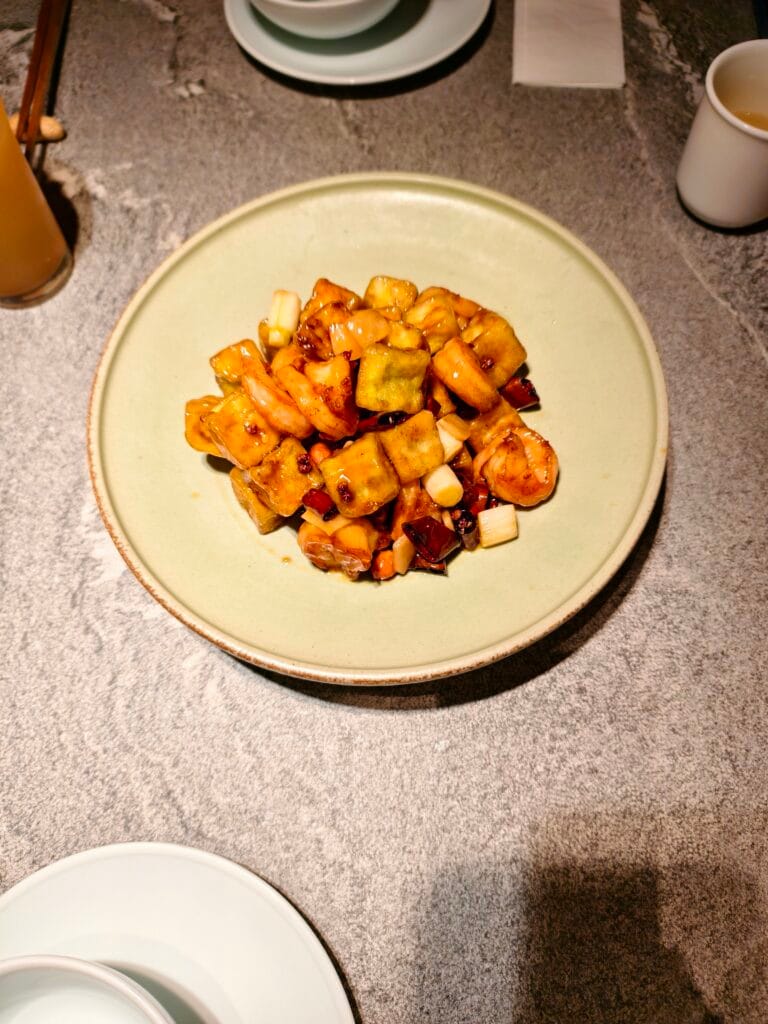
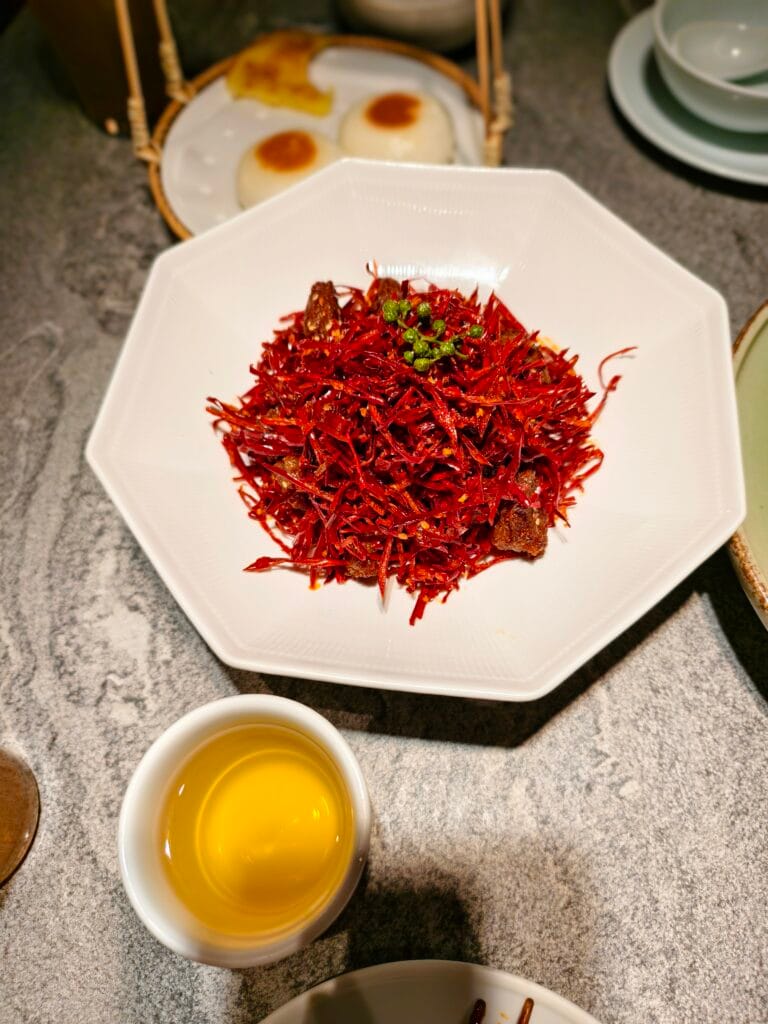
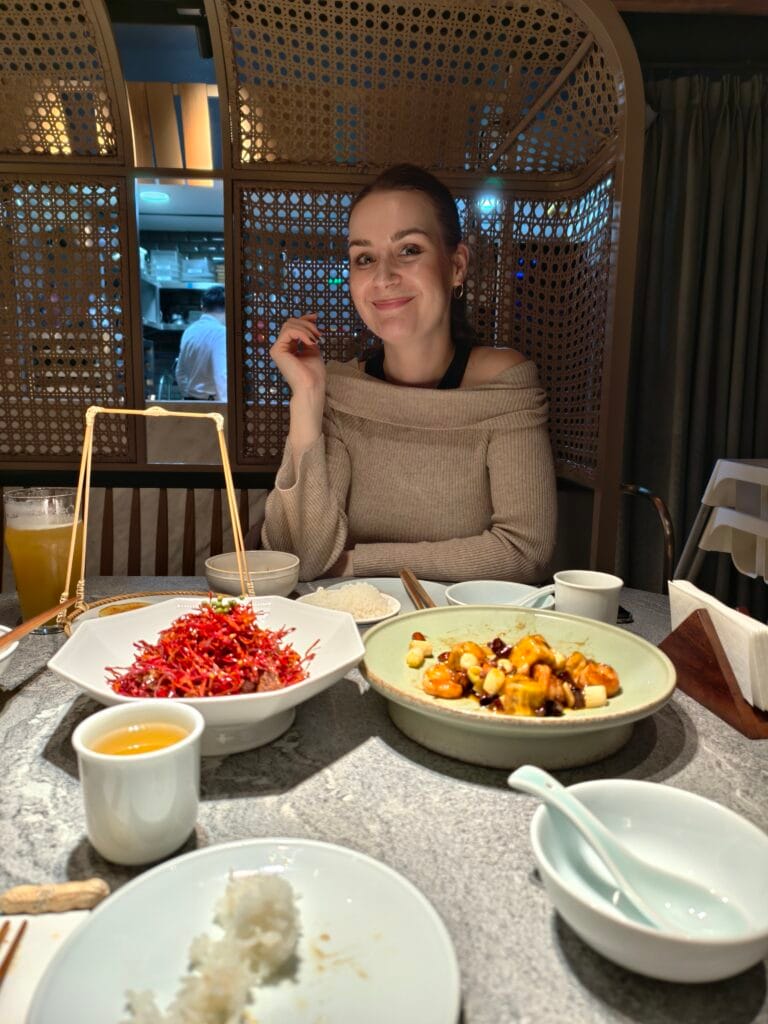
Ma’s Kitchen was a stumble upon type of thing. Saw it, walked in, ate amazingly well. Not as refined as Mi Xun, but the food had a punch to it. The names of dishes were names you’d recognize from your local Chinese takeaway, but the dishes were elevated to Michelin quality. We over-ordered because we wanted to try everything: kung pao chicken, beef with shredded chili, a couple of things I couldn’t name and didn’t ask about twice. That meal was even cheaper than Mi Xun.
We’d already done the hotpot thing properly in Chongqing (that city treats it like a competitive sport) so we didn’t chase it down again in Chengdu. But it’s worth saying: Sichuan hotpot is the dish the whole region is loosely famous for, Chengdu included, and it’s not just heat for the sake of heat. Bourdain called the region “the spicy, sensualist heartland of all the things I love about China.” when he came through, and hotpot is a big part of why. If you haven’t done Chongqing, don’t skip hotpot here on the strength of our decision…we just already had ours.
Dujiangyan vs. the Main Chengdu Panda Base: Why We Skipped the Famous One
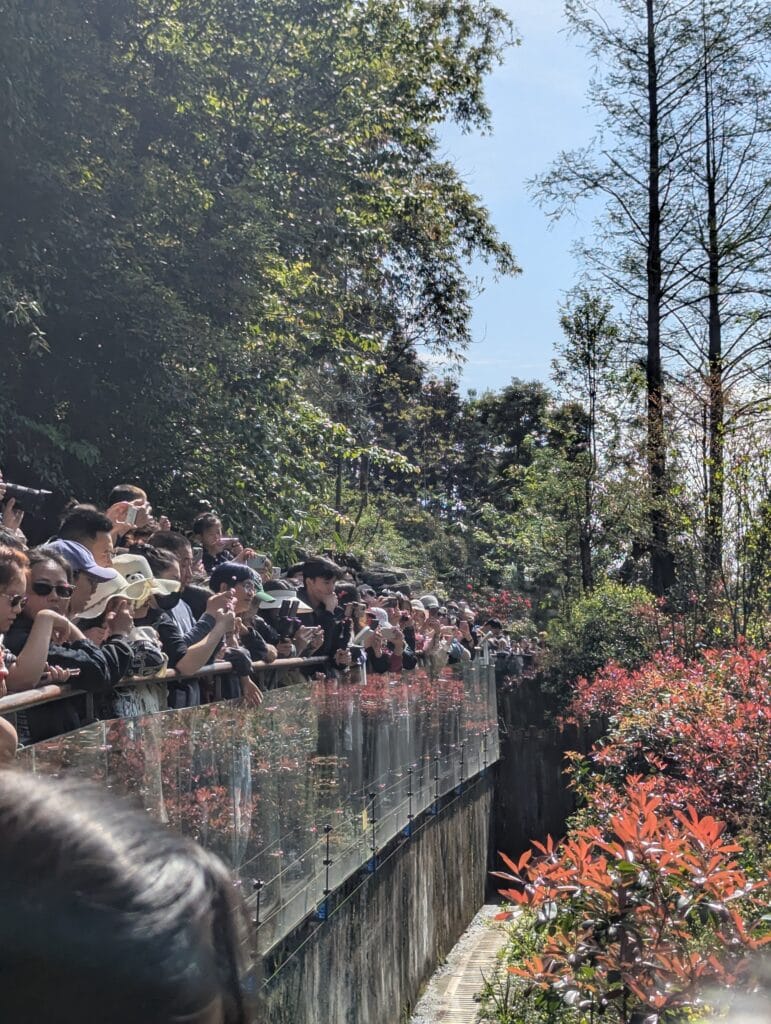
You can’t go to Chengdu without the panda question coming up. The main Chengdu Research Base is 10 km north of the city, costs 55 RMB ($8), and is absolutely mobbed by mid-morning. Time-slot entry, queues, crowds.
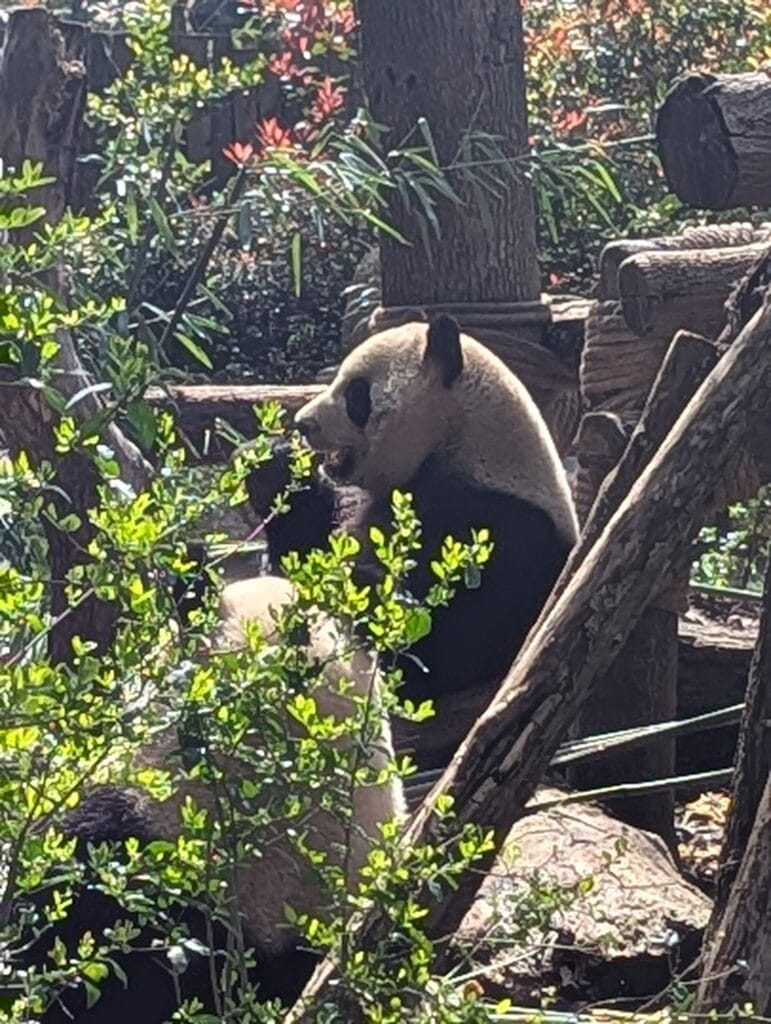
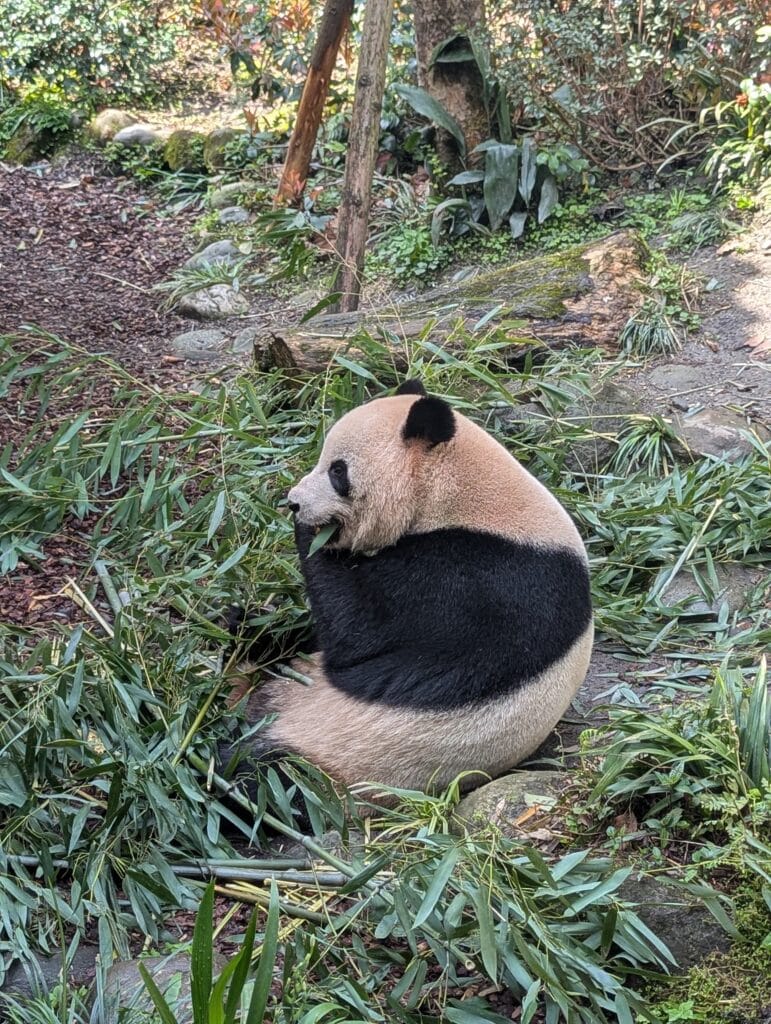
We chose Dujiangyan Panda Base instead. It’s further out (about an hour by DiDi and 130RMB / $20 each way ), but the trade-off is fewer people and no advance ticket requirement. The base is operated by the same organization as the main one, but it’s quieter and the enclosures feel more natural. We saw pandas eating, pandas sleeping (most of them), and one panda doing absolutely nothing while staring at a bamboo stalk for twenty minutes. That last one felt relatable.
The best viewing time is 7:30 to 9:30 AM, when they’re active and being fed.
There were red pandas too, off to the side and mostly ignored by the crowds chasing the giant ones, which felt like their loss honestly. The bamboo forest sections between enclosures were genuinely nice to walk through on their own, panda or no panda in sight.
Book unique Panda experiences with Klook or Viator.

Where to Stay in Chengdu (and what’s worth the splurge)
⭐⭐⭐Upper House Chengdu – See rates & availability →
⭐⭐Crowne Plaza Chengdu – Go stalk the prices →
⭐Dorsett Chengdu – Peek at rates →
We stayed at Crowne Plaza Chengdu City Center. Standard business hotel done well. The room was clean, the air conditioning worked (non-negotiable for me), and we had breakfast more affordably nearby (as you’re literally on a massive street with hundreds of eateries). We got around mostly by walking and DiDi, used the metro a few times. Chengdu’s metro is clean, cheap, and has announcements in English. No complaints. Good price and central.
Luxury alternative: Upper House Chengdu: right in Taikoo Li, next to Daci Temple. This is the same hotel as Mi Xun Teahouse (affordable Michelin) Runs roughly $300–380/night, Quiet, but in the middle of a very busy shopping area. We visited the hotel and teahouse and the place looked amazing.
Budget alternative: Dorsett Chengdu: 4-star, Chengdu City Centre, around $41/night. Good value pick without dropping into hostel territory.
Chengdu Travel Tips: Getting Around, Connectivity, and What to Pack
When to go: March–April or October–November. Avoid July–August unless you enjoy being a sweatier version of yourself.
Getting around: DiDi is the Chinese Uber. Works fine. Have the address written in Chinese. The metro covers most tourist areas. We walked a lot because Chengdu is flat and the scale is manageable.
Pandas: Choose Dujiangyan over the main city base unless you’re short on time or love crowds. Get there by 8 AM.
Cooking class: Chili Cool China, ask for Jerry.
Michelin: Mi Xun Teahouse or Ma’s Kitchen for affordable deliciousness.
What to eat: Mapo tofu (you will not find better outside Chengdu), dan dan noodles, Sichuan hot pot, chuanchuan xiang, and egg tarts.
eSIM: Grabbed an Airalo eSIM before landing and had data the second we touched down that bypasses the great firewall. In fact, get ALL the apps you’ll need for China, like AliPay and AMAPS.
Cooking class booking: We booked ours directly, but Chili Cool China (and similar Chengdu cooking classes) show up on Viator too if you want it bundled with your other trip bookings.
Travel insurance: Didn’t need to file a claim this trip but SafetyWing is always running in the background. The one time you really need it, you’ll be very glad you have it.
What we packed: What I always bring on every trip, plus good walking shoes, and space in your luggage for spices. A good camera for photographing the Pandas. If you need anything, just buy it locally as the place is full of huge malls and markets.
One honest complaint: the Meituan delivery drivers weaving through the pedestrian zone on scooters with zero regard for anyone walking. It stood out because Chengdu otherwise felt like a city where people mostly follow the rules. Good for efficiency, bad for your ankles. Small gripe. I felt better getting it off my chest.
FAQs About Visiting Chengdu
More Tips for Your China Trip
- China Travel Logistics: Everything You Need Before You Go
- Where to Stay in Xi’an
- What to Do and What to Eat in Xi’an
- Dressing up in Hanfu in Xi’an
- Visiting Niushoushan, Nanjing’s Hidden Buddhist Park
- Suzhou Travel Guide: Watertown Day Trip from Shanghai
- Visiting Shanghai Disneyland as Adults
- Eating at a North Korean Restaurant in Shanghai
- Where to Stay in Beijing
- Visiting the No-Crowds Section of the Great Wall at Simatai
- China High-Speed Rail Guide
- Things to Do in Chongqing
- Chengdu Itinerary
- Visiting the Panda Bases in Chengdu
- What to Eat in Chengdu
Full disclosure: Some links here are affiliate links. If you use them, I get a tiny kickback at no cost to you, which keeps this site running and fuels my travel coffee habit. I only recommend tools I actually used.