Visiting Petra Complete Guide: Tickets, Tips, & Scams (2026 Guide)
TL;DR
Visiting Petra let’s you see one of the New Seven Wonders of the World and it earns every bit of that reputation. But it’s also a full-contact travel experience. You’ll walk 15-20km in a day. Bedouin vendors will physically touch you trying to sell you things. The horse ride included in your ticket comes with pressure to pay more. The dogs roaming the site will adopt you for an hour. The Monastery is better than the Treasury. Two days is the right call. Buy the Jordan Pass before you arrive. Enter through the back door from Little Petra. Don’t skip the Siq. Do skip the carriage ride.
Who this guide is for: First-time visitors who want the honest version: what to actually expect, where the scams are, how to avoid the crowds, and whether the Monastery is worth the hike.
Is Petra Safe to Visit?
The short answer is yes. I say this as someone who’s been to 76 countries and has had genuinely bad experiences in other parts of the Middle East. Jordan was different. Petra felt safe the entire time. Jordan’s located in the middle of an often active conflict zone, so get your insurance and do your due diligence when deciding if Jordan is safe right now.
The longer answer is that “safe” in Petra has two meanings. The site itself is safe…well-patrolled, clear paths, no security concerns. The street-level interactions, though, can be intense. Some Bedouin vendors in Petra are aggressive. Physically grabbing your arm, kids begging, treating you like a wallet. That’s not dangerous. It’s just exhausting.
Once you know it’s coming, it’s manageable. You say no, you keep walking, and you don’t engage. The people who actually live and work in Petra: your hotel staff, the JETT bus driver, the chef who asks what time you want breakfast, are some of the most genuinely hospitable people I’ve met traveling.
How to Get to Petra from Amman
There are four ways to do this. I’ll rank them by what makes sense for your situation.
By JETT bus (the budget option). This is what most independent travelers do, and it’s the move if you’re not renting a car. JETT departs from the terminal at 7th Circle (some buses run from Abdali) around 6:30-7:00 AM and arrives in Wadi Musa roughly 3.5-4 hours later. One-way fare is around 11 JD (~$15 USD) if you book direct through JETT. Do not book through third-party comparison sites,they’ll quote you double or triple. Book at jett.com.jo directly, or at the terminal a day ahead if you can.
Our take: We took JETT and there were four people on the bus. The AC was set to “meat locker.” Bring a layer, find a window seat on the right for the desert views, and sleep the first two hours because the landscape doesn’t get interesting until you hit the Karak plateau.
By private transfer or taxi. If you’re short on time or traveling with a group, this is the move. It’s faster — about 3 hours via the Desert Highway and runs 70-100 JD per car, not per person. That means if there are three or four of you splitting it, it can actually work out cheaper than JETT. Your hotel can arrange this, or book ahead online.
By minibus. Lesser-known but worth asking about. Some hotels can book you a seat on a daily minibus running the same route for around 10 JD. The schedule is looser and the comfort level varies, but if the JETT timing doesn’t line up with your flight, it’s a decent backup.
Self-driving. The road is a straightforward highway drive, nothing technical. Budget around 3 hours plus stops. This is the right call if you’re planning to continue on to Wadi Rum or Aqaba afterward instead of looping back through Amman. The rental car math makes more sense the further south you’re going.
How Many Days Do You Need in Petra?
Two days. That’s the answer.
Here’s the math. A 1-day ticket for accommodated visitors is 50 JD. A 2-day ticket is 55 JD. For five extra Jordanian dinars (about $7 USD), you get a second day. That’s not a decision…that’s a rounding error.
One day lets you walk the main trail, see the Treasury, the Siq, the Theatre, and maybe rush to the Monastery if you’re fit and fast. Two days lets you do the Monastery properly, explore the back trails, visit the museum, and sit in a cave and think about the Nabataeans without feeling like you’re on a timer.
We did two days and it was the right call. We entered through the back door from Little Petra on day one, hit the Monastery, walked the main trail in reverse, and exited through the Siq. Day two we went back in the front, took our time with the Treasury, the Royal Tombs, and the museum. Perfect pace.

How many days in Petra if you’re on a tight schedule?
One day works. But you’ll be tired, you’ll miss the Monastery, and you’ll leave wishing you had more time. Two days is the sweet spot.
How long is the Siq walk?
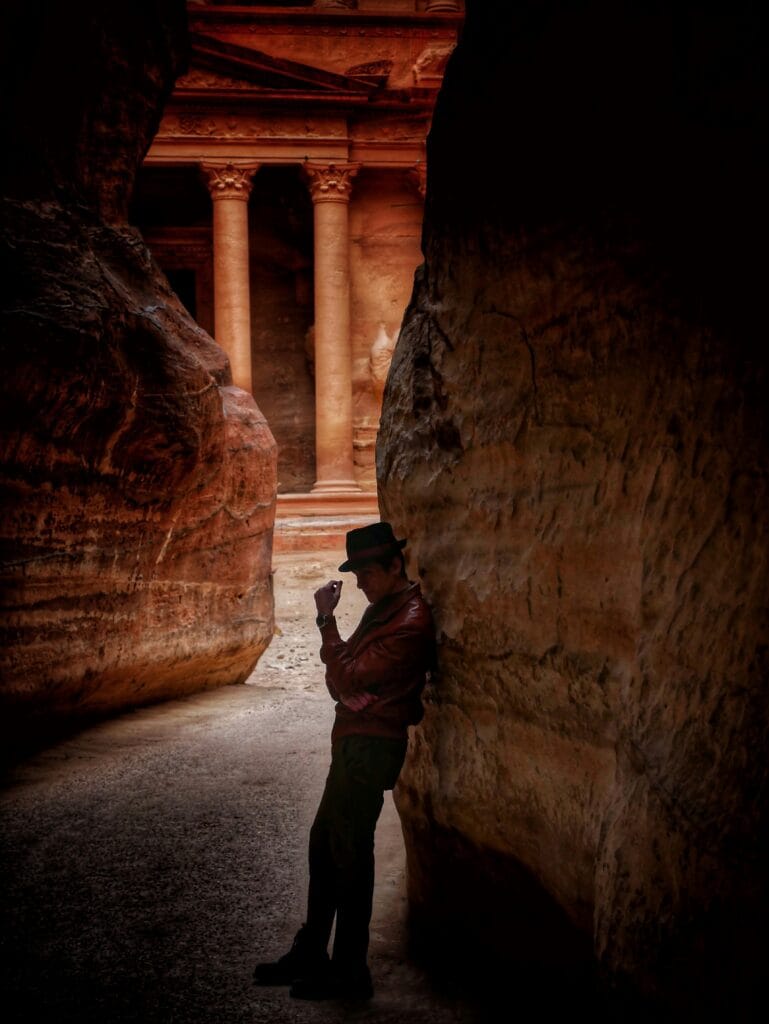
The walk from the Visitor Centre to the Treasury is about 3.9 km one way. The first 1.2 km of that is the Siq. A narrow, winding gorge with sandstone walls rising up to 80 meters on either side.
The Siq is not a quick walk-through. It’s the main event. Plan for 30-45 minutes at a leisurely pace. You’ll stop to look at the water channels carved into the rock, the niches with god blocks (baetyls) that were there to protect travelers, the dramatic color shifts in the sandstone. If you walk it without stopping, 20 minutes.
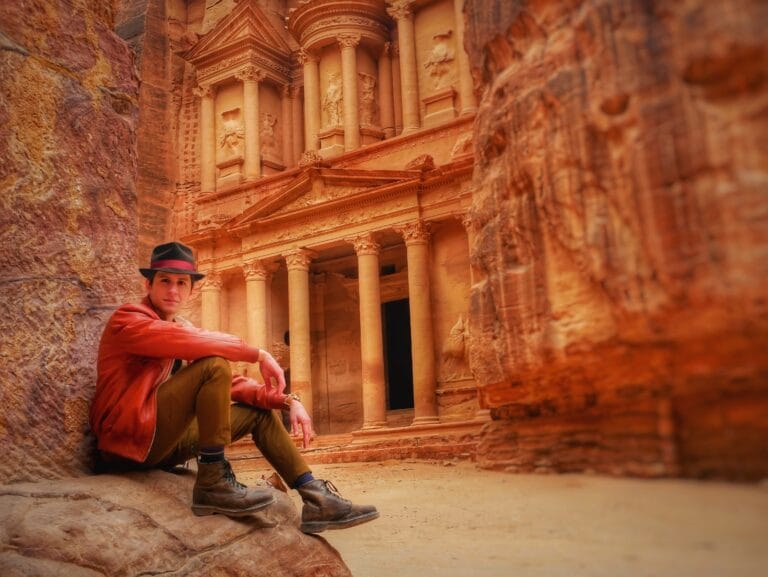
The Siq ends with The Reveal… that famous moment where the gorge opens and you see the Treasury for the first time. It’s theatrical and intentional and the Nabataeans designed it that way. Worth every step.
Is the Walk to Petra’s Treasury Hard?
No. It’s flat. It’s mostly even ground. The Siq is paved in sections. If you have mobility issues, there are club cars available (15 JD one way, 25 JD round trip from Visitor Centre to Treasury). But you’ll miss the Siq, and the Siq is half the experience.
Little Petra to Petra: The Secret Back Entrance Route
This is the single best decision you can make for your Petra visit. Here’s how it works.
Step 1: Go to Little Petra (Siq al-Barid), about 15 minutes north of the main entrance. Little Petra is free, no ticket needed, not even the Jordan Pass. It’s a smaller version of the main site, what historians believe was a suburb or caravan rest stop. Worth an hour on its own.
Step 2: At Little Petra, buy a ticket for the 4×4 shuttle (5 JD) at the second window of the first shack on the left. The shuttle runs from 7:30 AM to 3:00 PM and takes about 15-30 minutes over a rough dirt track. They’ll check your Jordan Pass or Petra ticket at a checkpoint along the way.
Step 3: The shuttle drops you at the start of the back trail. From here, it’s about 2.3 km to the Monastery, roughly 45 minutes to an hour of hiking. The trail goes up – there are stairs, some steep sections, and the last part is a narrow path above a drop. But it’s nothing compared to the 800 steps you’d climb from the main trail.
Step 4: You reach the Monastery. It’s huge. Spend time there. Then walk down the 800 steps (yes, downhill, which is better) to the main trail, past the Royal Tombs, the Theatre, the Street of Facades, and the Treasury, and exit through the Siq.
Total time: About 4-5 hours from Little Petra to the Visitor Centre, depending on how long you stop.
The alternative: Hike the full 7 km from Little Petra without the 4×4. This takes about 2-2.5 hours to reach the Monastery. The trail is mostly flat through open desert for the first half, then goes uphill. You’ll pass a Neolithic village. The views are spectacular. But in summer, the exposed trail is brutal.

Visiting Petra’s Main Trail: Everything You’ll See
If you enter through the front door (which is fine, you’ll do both days if you’re smart), here’s the order:
- Visitor Centre → Buy tickets or show Jordan Pass
- Siq (1.2 km) → The gorge, the water channels, the buildup
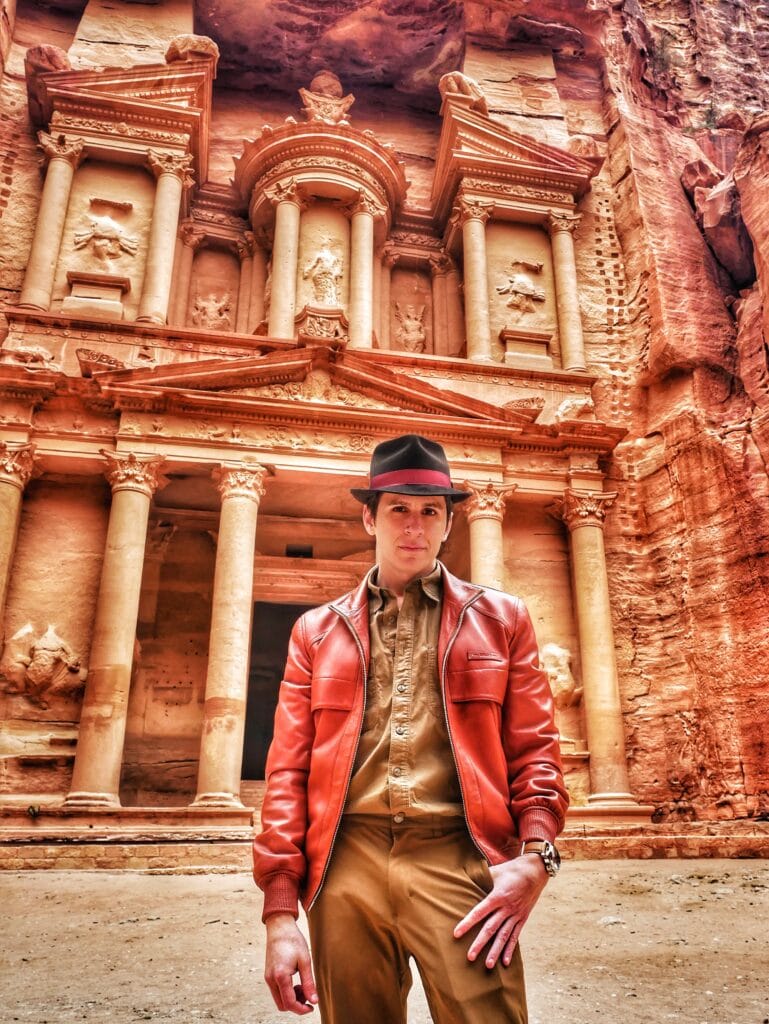
- Treasury (Al-Khazneh) → The famous one from Indiana Jones. 39.5 meters tall. Carved from a single block of sandstone. Likely a mausoleum for King Aretas IV, not a treasure vault. The urn on top is solid stone – no hidden treasure.
- Street of Facades → Row of tombs that get less intricate but still impressive
- Theatre → Roman-era, cut into the rock, seats 3,000
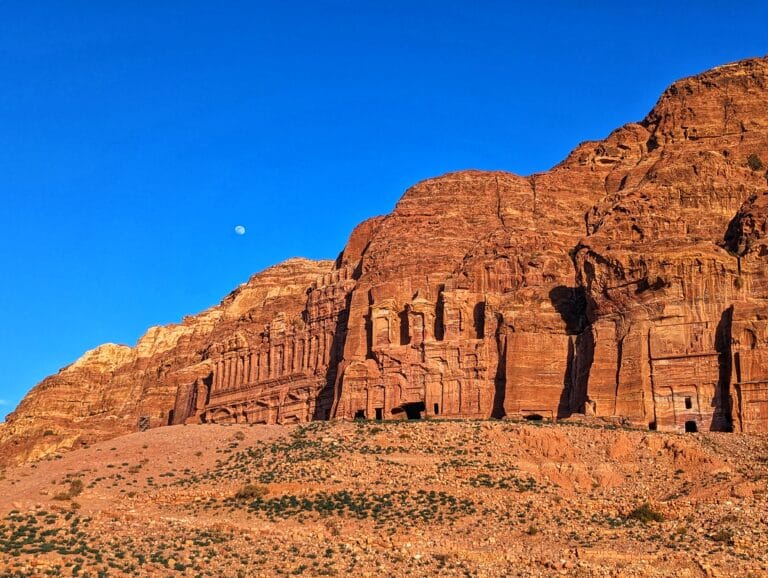
- Royal Tombs → The Urn Tomb, Silk Tomb, Corinthian Tomb, Palace Tomb. The Silk Tomb has incredible color banding.
- Colonnaded Street → The main thoroughfare of the ancient city
- Qasr al-Bint → The main temple, one of the few freestanding structures
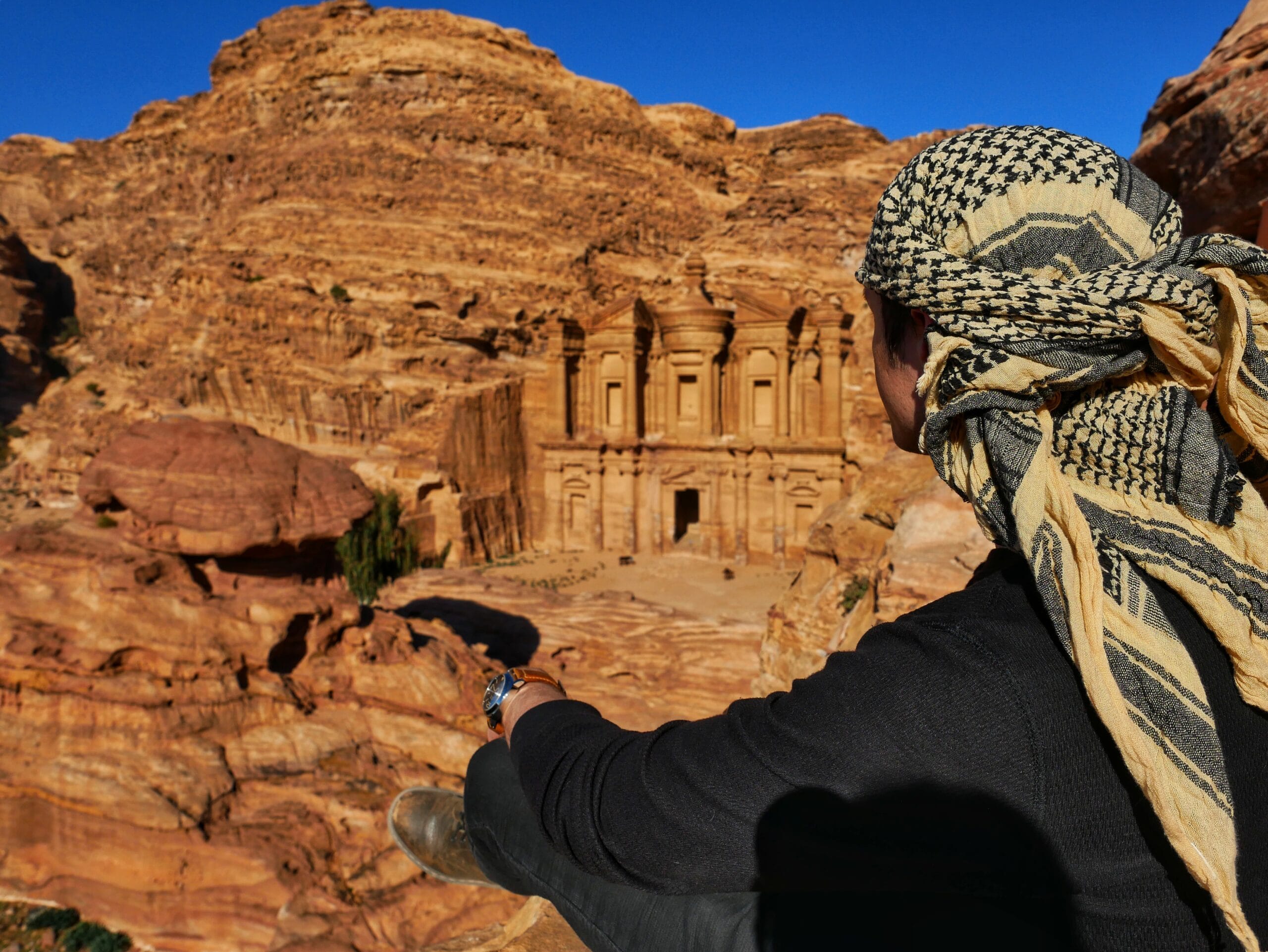
- Monastery (Ad-Deir) → 800 steps up from here. 48 meters tall. Petra’s largest monument.
Or if you do the back door, you see it in reverse, which has the advantage of ending with the Treasury reveal from the Siq – which is arguably the best way to finish.
Petra Monastery vs Treasury: Which Is Better?
The Treasury is the famous one. It’s the face of Petra and the one we recognize from Indiana Jones. The dramatic reveal at the end of the Siq is one of archaeology’s great theatrical moments. You’ll take photos. You’ll be impressed. It’s worth every minute of the walk.
During high season (without regional conflicts) this area is massively crowded. Vendors, instagrammers, camels, all aiming to get a special moment in front of the world wonder.
But the Monastery is better.
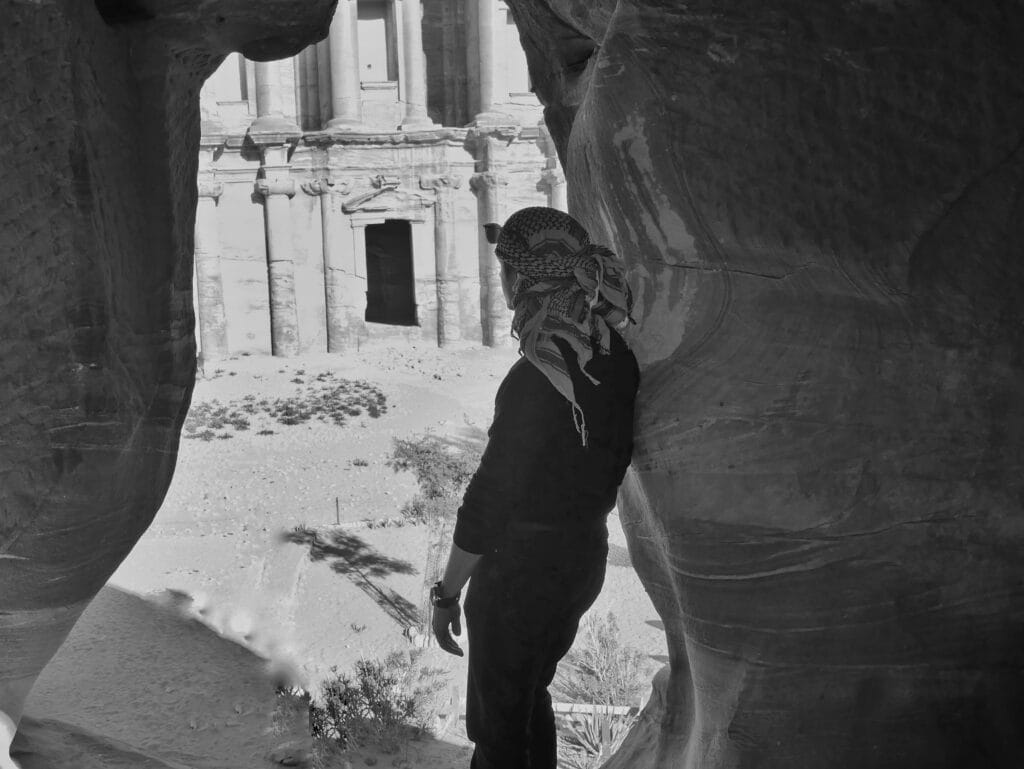
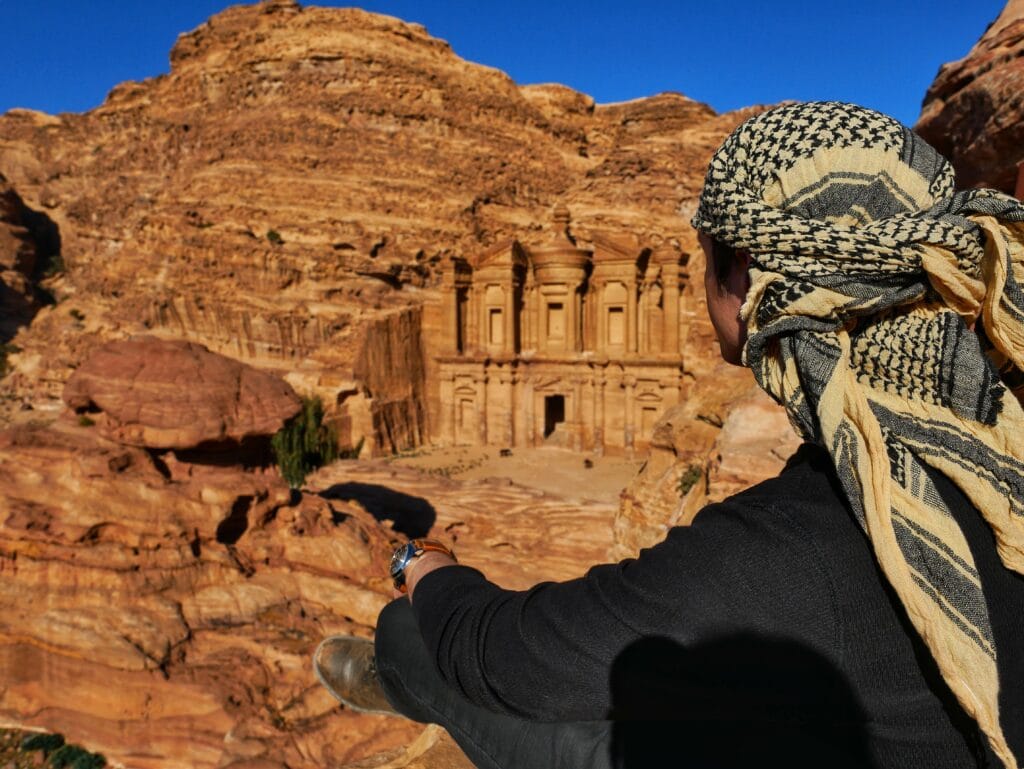
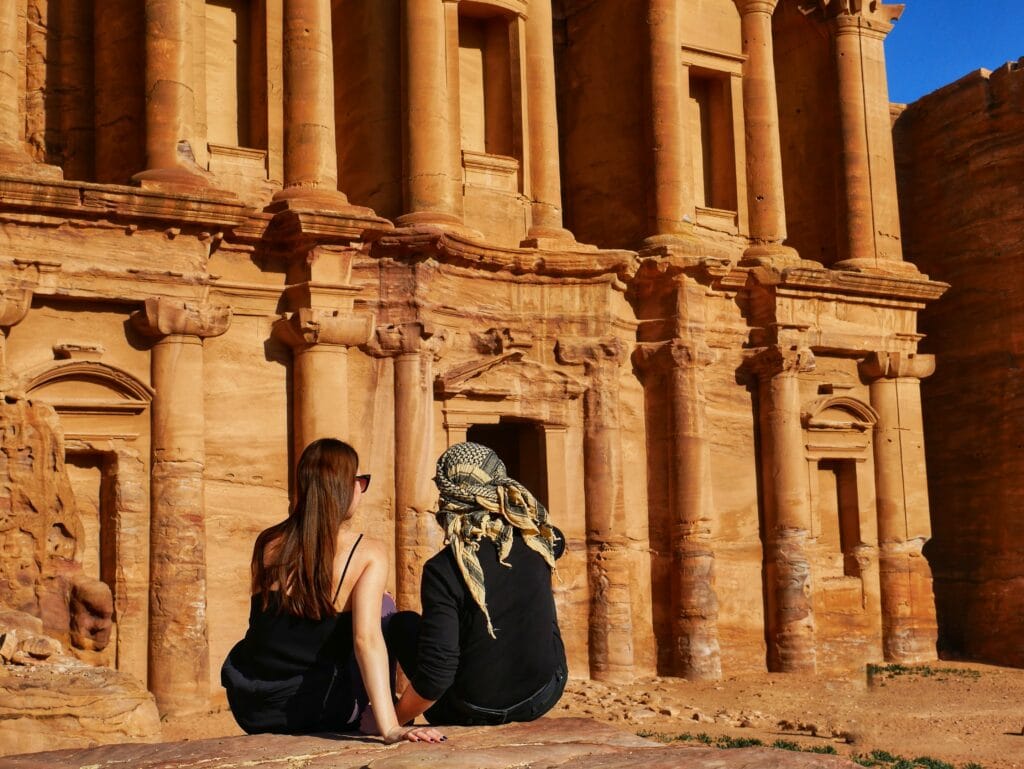
It’s bigger – 48 meters high, 47 meters wide, compared to the Treasury’s 39.5 meters. It’s better preserved. And because it’s harder to reach (800 steps from the main trail, or a 7 km hike from Little Petra), it’s much less crowded. You can stand in front of it and actually feel the scale.
Is the Monastery worth it? Yes. Even if you skip everything else, do the Monastery. Take the back door to save your legs, walk down the 800 steps, and then do the rest of Petra. That’s the optimal order.
Treasury or Monastery — Which Should You Prioritize?
If you only have one day and can’t do both: do the Treasury in the morning and the Monastery in the afternoon. You’ll be tired, but you’ll have seen the two best things. If you have two days, do the Monastery via the back door on day one and the Treasury on day two when you enter through the main gate. If you get tired or desperate, you can negotiate a donkey ride to get you back to your starting point sooner.
Visiting Petra Scams (And How to Avoid Them)
I’m not going to sugarcoat this. The vendor situation in Petra is the worst part of the experience. Here’s what to watch for:
Ticket fraud. People near the entrance will claim to sell official tickets or tell you that you need a special guide. You don’t. Buy your ticket at the official Visitor Centre counter or get the Jordan Pass online before you arrive.
The “free” horse ride. Your Petra ticket includes a horse ride from the entrance to the start of the Siq. But the handlers will pressure you for a tip, and then pressure you harder. Some will try to switch the price after you’ve ridden. Say no, tip a small amount if you feel generous, and walk away.
Camel and donkey price-switching. You’ll be quoted one price for a ride and then asked for double or triple after you get off. Agree on the exact price before you mount. Better yet, walk.
Photo spot pressure. Some Bedouins have set up “photo spots” with good angles and will demand money if you take photos there. The upper viewpoints overlooking the Treasury are now closed and not accessible. Don’t plan on those.
Romance scams. Less common, but reported, especially targeting solo female travelers. Friendly locals who want to “show you around” and then pressure for money or more.
The approach: Know it’s coming, don’t engage, and keep walking. A firm “no” with eye contact works better than a polite “maybe later.” I’m not saying this to scare you — I’m saying it so you know what to expect. The site itself is incredible. The sales pressure is just something you deal with.


Visiting Petra Entrance Fees and the Jordan Pass
Here’s the full breakdown.
Petra entrance fees (accommodated visitors – staying overnight in Jordan):
- 1 day: 50 JD (~$70 USD)
- 2 days: 55 JD (~$77 USD)
- 3 days: 60 JD (~$85 USD)
Non-accommodated visitors (day-trippers from Israel or Saudi Arabia):
- 90 JD (~$127 USD)
Children under 12: Free during daytime hours.
The Jordan Pass is the smarter buy. It bundles your tourist visa fee (40 JD) with entry to Petra and 40+ other sites. The tiers are:
- Jordan Wanderer (1-day Petra): 70 JD
- Jordan Explorer (2-day Petra): 75 JD ← This is what we bought
- Jordan Expert (3-day Petra): 80 JD
The math: 75 JD for the pass vs 40 JD visa + 55 JD 2-day Petra = 95 JD separately. You save 20 JD and you don’t queue for a visa on arrival.
Requirements: Buy before you arrive. Minimum 3 consecutive nights in Jordan. Valid for 2 weeks after first scan.
Petra by Night: 30 JD extra. Not included in the Jordan Pass. Monday, Wednesday, Thursday. 8:30 PM to 10:30 PM. Looks amazing actually but ony possible a few nights a week.
Opening hours: Summer 6:00 AM – 6:00 PM, Winter 6:00 AM – 4:00 PM. Ticket sales stop about 45 minutes before closing.
Don’t forget to grab an eSim before arriving to stay connected.
Where to Stay when Visiting Petra
In a Rush? Same. Here’s Where to Stay in
⭐⭐⭐Movenpick Resort Petra – See rates →
⭐⭐Petra Boutique Hotel – Go stalk the prices →
⭐Nomads Hotel – Peek at rates →
The town next to Petra is called Wadi Musa. Don’t search for “hotels in Petra” search for Wadi Musa. The key is proximity to the entrance. You’ll be walking 15-20 km inside Petra. The last thing you want is a 20-minute uphill walk back to your hotel.
Where we stayed: Petra Boutique Hotel. We were the only guests. The chef asked us what time we wanted breakfast and made an absurd spread for two people. Quiet, affordable, comfortable, and close to the entrance.
Other good options:
- Mövenpick Resort Petra — Right at the entrance. 5-star. Convenient but expensive.
- Petra Moon Hotel — 100 yards from the gate. Good value. Rooftop pool.
- La Maison Hotel — 5-minute walk. Boutique feel. Good value.
- Petra Guest House — Literally at the entrance. Has a bar in a Nabataean cave.
- Petra Marriott — 10 minutes by taxi. Better views, worse location.
Budget options: Nomads Hotel, Petra Plaza Hotel
For a unique experience, consider Seven Wonders Luxury Camp near Little Petra if you want to do the back door trail first thing.
Travelling around Jordan? Here’s where to stay in each stop.
What to Wear to Visiting Petra
This is not a casual walk. You’ll be on your feet for 6-8 hours on uneven terrain in the direct sun. Dress accordingly.
Footwear: Sturdy shoes with good grip. Hiking boots or trail runners. I saw people in flip-flops. I assume they regretted it.
Clothing: Layers. Start early (6 AM) and it’s cold. By midday, it’s hot. A light jacket or fleece for the morning, a t-shirt underneath. Long pants are better than shorts for sun protection and respect for local customs.
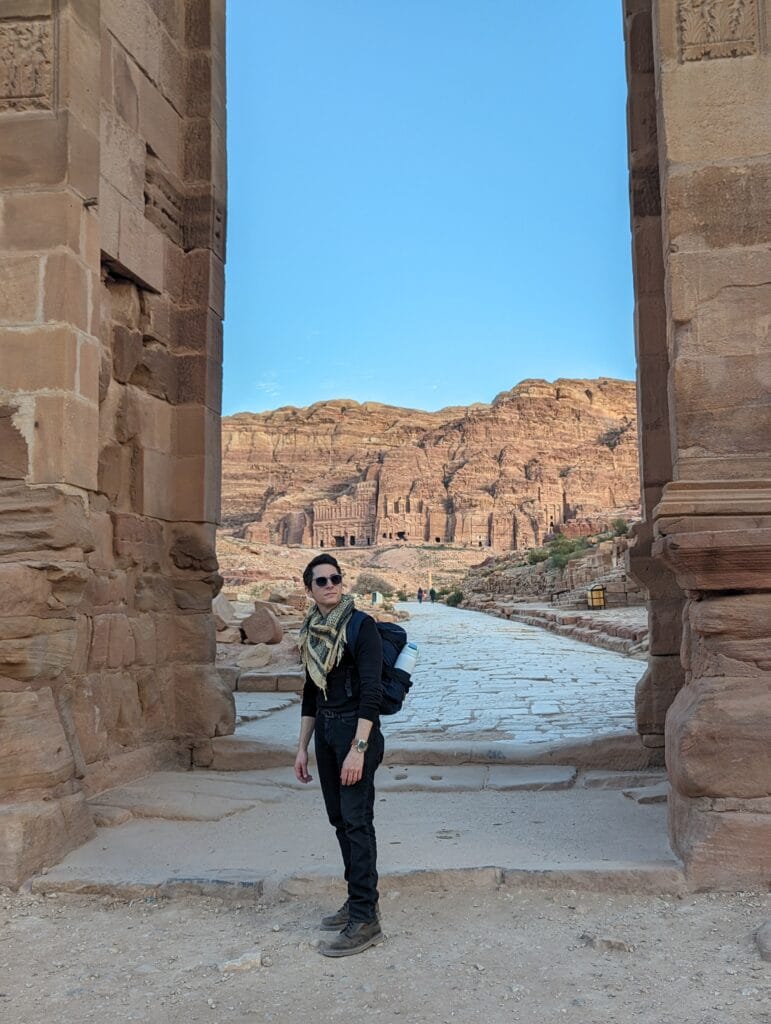
Modesty: Jordan is a Muslim country. Cover shoulders and knees. You don’t need a headscarf, but a scarf or shemagh is useful for sun, dust, and visiting any religious sites.
Sun protection: Hat, sunglasses, sunscreen, lip balm. The sun is strong even in winter.
Water: Carry at least 2 liters. There are shops inside the site but they’re overpriced.
Backpack: 15-20 liters. Enough for layers, water, snacks, and your passport.
Do You Need a Guide Visiting Petra?
No. You can absolutely do Petra on your own. The main trail is clear, well-marked, and easy to follow. The back door trails are less obvious; you’ll want downloaded offline maps if you go that route without a guide.
That said, a guide adds real value. The signage inside Petra is minimal. There’s a lot of history you’ll miss without someone explaining it. Official guides at the Visitor Centre cost 50 JD for the main trail (3 hours) or 100 JD for the main trail plus Monastery.
My take: Do your first day self-guided so you can set your own pace. If you’re really into history, hire a guide for the second day to go deeper on the areas you liked most.
What to Expect Visiting Petra
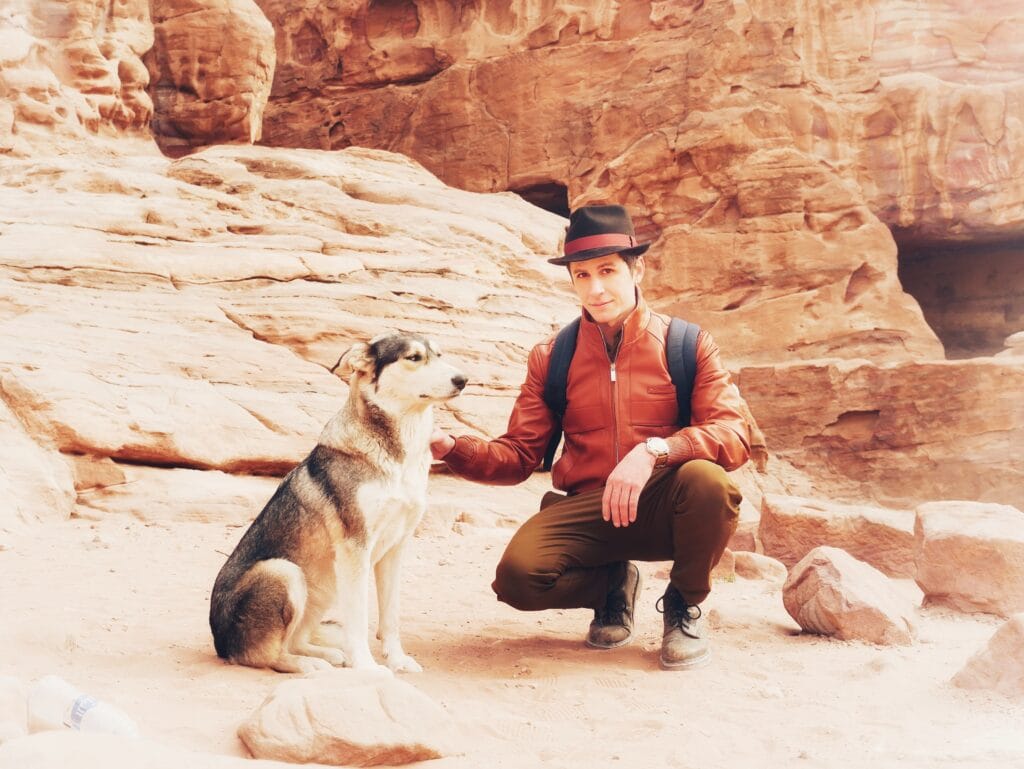
The dogs. I need to mention the dogs. Random local dogs will join you as you walk through Petra. They’ll walk with you for an hour, sit with you while you rest, and then disappear when they’re done. We walked with one for about 45 minutes. It was the best part of the day.
The vendors will ask you the same question every 30 seconds: “Where you from?” “You want a ride?” “Good price for you.” “Free to look.” It gets old.
The horse ride included in your ticket is technically free. The handler will ask for a tip. You’ll feel awkward. Tip 2-3 JD if you want, or hand the reins back and walk. Neither is wrong.
The Monastery hike is hard but worth it. The 800 steps from the main trail are a grind. The back door from Little Petra is the smarter route. Do the back door.
The real move Petra day turned out to be just walking uphill along the main road away from the tourist zone. There’s a stretch where the hotels thin out and it becomes just… a town. People live here. We stumbled into a bakery where someone was pulling pita rounds out of a dome oven so fast they were stacking on the ceiling. Literally falling from above. We sat down and ate falafel, shawarma, and kunafa that cost roughly the same as a wink, surrounded entirely by locals. (I do not remember the name of this place. It was not on any list. It was just there.)
Is Visiting Petra Worth It?
Yes. Unequivocally. It’s one of the most impressive places I’ve ever been, and I’ve been to 76 countries across all seven continents.
But it’s not a passive experience. You don’t show up, take a photo, and leave. Petra demands something from you. It demands that you walk. That you deal with the vendors. That you climb the steps. That you sit in the dirt and eat a dry biscuit because the restaurant at the Basin is overpriced and the food looks mediocre.
And if you give it what it asks, it gives you something back. The moment you turn the corner at the end of the Siq and see the Treasury for the first time. The view from the top of the Monastery looking across the valley. The feeling of standing in a 2,000-year-old tomb with no one else around.
I went in expecting to be impressed. I came out changed.
FAQs About Visiting Petra
I went to Petra expecting great architecture. I got that. What I didn’t expect was the full sensory experience of the place, the way the light changes the color of the rock from pink to gold to orange throughout the day, the silence of the back trails, the dogs that adopt you for an hour and then move on to their next person.
The scammers are annoying. The animal situation is sad. The vendors are relentless. None of that changes the fact that Petra is one of the most remarkable places humans have ever built.
Go. Take the back door. Eat the kunafa. Pet the dogs.
Check out our full Jordan guide.
Plan Your Trip to Wadi Rum
Disclaimer: This post contains affiliate links. If you make a purchase through these links, I may earn a commission at no extra cost to you.